Great coffee doesn't just happen when water meets the bean; it starts the moment you turn on your grinder. While it’s tempting to grab the quickest, cheapest tool for the job, how you crush your coffee determines everything about how it tastes. We are breaking down the real differences between burr and blade grinders so you can ditch the guesswork and choose the right setup for your kitchen counter.
Key Takeaways
- Consistent particle size is the absolute foundation of balanced extraction and great-tasting coffee.
- Blade grinders, by randomly chopping beans, produce an unpredictable mix of fine dust and large chunks, resulting in muddy flavors.
- Using two abrasive surfaces, burr grinders crush beans to a uniform size, giving you the exact control you need to elevate your daily brewing ritual.
What Is a Blade Coffee Grinder?

A blade coffee grinder is an entry-level tool that uses a spinning metal propeller to chop coffee beans. Structurally similar to a standard kitchen blender, it features a large, open chamber where beans bounce around and hit the spinning blades at random angles. Rather than using an engineered, adjustable setting, the final grind size depends entirely on duration—the longer you run the motor, the finer and more chaotic the particles become.
Where blade grinders fall short
While blade grinders are budget-friendly and widely available, their mechanics make them ill-suited for quality coffee brewing. The aggressive chopping motion inherently lacks precision, leading to several major drawbacks in the cup:
- Inconsistent grind size: Blades often grind your coffee unevenly, resulting in a mix of fine powder and larger chunks of coffee. This is partially because blade grinders typically have a large chamber for the beans, with blades at the bottom (like a blender). This results in an uneven experience for the beans, as they bounce around the chamber and hit the blades at different angles during the grind.
- Limited grind control: Grinding by duration can make achieving the right coarseness for different brewing methods difficult.
- Heat generation: Fast-spinning blades create friction and, therefore, heat, which can be detrimental to the final flavor of the coffee.
What Is a Burr Coffee Grinder?

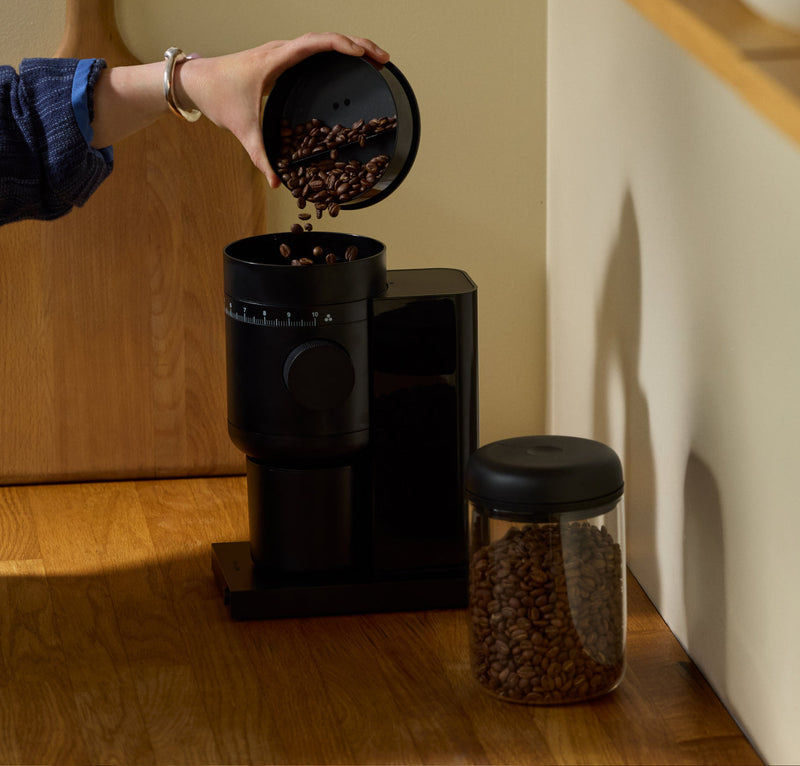
A burr grinder takes a fundamentally different, precision-engineered approach. Instead of chopping, it utilizes two burrs, one fixed and one rotary, to crush beans to a uniform size. The sharp burrs gently crush the coffee beans as they pass through, and the exact distance between these two burrs dictates the resulting grind size. By adjusting this distance, you gain clear, to-the-millimeter control over your grind.
With consistent grinding and adjustable grind settings, burr grinders are ideal for precision coffee brewing, whether espresso, French press, pour-over, or other methods. Burr grinders also operate at a slower and more controlled speed compared to blade grinders, which prevents heat buildup and helps preserve the coffee’s flavors.
Flat and Conical Burr Grinders Explained
To address the mechanical shortcomings of blade grinders, burr grinders use specific geometries to control how the bean is broken down. There are two main types to know:
-
Conical burr grinders feature a cone-shaped inner burr resting within a ring-shaped outer burr. Aided by gravity, sharp, angled teeth gently pull the coffee down into the grind chamber. Conical burrs tend to produce a specific ratio of fines to larger particles, which creates the resistance necessary for high-pressure brewing, making them excellent for espresso.
-
Flat burr grinders utilize two parallel rings with serrated edges that crush the coffee, using centrifugal force to push the grounds out. Specialty coffee drinkers often favor flat burrs for filter coffee, as they offer an incredibly uniform particle distribution that yields striking flavor clarity and separation in the cup
How Do Blade and Burr Grinders Differ?

Blade and burr grinders carry several differences that can dramatically affect your cup of coffee.
Price
Blade grinders are often more affordable, sometimes costing as little as $20. Burr grinders are typically more expensive, depending on the brand, quality, and features. While burr grinders require a bigger investment than blade grinders, they provide long-term value by significantly improving the quality of your coffee.
Grind Consistency
The pulverizing action of a blade grinder is suitable for milling spices or brewing coffee in a pinch, but it can’t deliver the same consistency and quality as a burr grinder. Even particle sizes and gentler grinding mean burr grinders outperform blade grinders.
Longevity and Durability
Blade grinders generally have basic motors and plastic parts with relatively short lifespans compared to burr grinders. With high-quality engineering, powerful motors, and durable materials, burr grinders have a longer expected lifespan. Burr grinders typically cost more upfront, but their longer lifespans equate to fewer replacements and lower overall costs.
Maintenance
Since coffee oils and fine powder residue can build up in small nooks and cavities, coffee grinders require more than a wipe-down with a paper towel. Burr grinders, despite their many parts, are usually easier to clean since their designs are meant for periodic disassembly. Blade grinders often don’t have easy access to remove the blades and perform a proper deep clean.
How to Choose a Coffee Grinder for Your Home
If you are learning how to choose a coffee grinder for your routine, remember that honoring the craftsmanship of your beans requires the right tool. Blade grinders may be budget-friendly, but their inconsistent grounds consistently mask the true potential of your coffee.
Here at Fellow, we bridge the gap between the professional café and the home kitchen with two thoughtfully designed burr grinders:
- Opus Conical Burr Grinder: An all-purpose powerhouse for everything from true 9-bar espresso to cold brew. It’s a fantastic, beginner-friendly upgrade for brew-it-all homes.
- Ode Brew Grinder Gen 2: A flat burr grinder designed exclusively for brewed coffee. Offering outstanding consistency for pour-over, French press, and cold brew, it is perfect if you’re primarily a drip coffee drinker looking to elevate your flavor clarity.
Why You Should Grind Your Own Coffee

Even with the best grinder in the world, freshness is paramount. Grinding your coffee right before brewing allows you precise control over your extraction, maximizing taste and complexity.
Once coffee is ground, the oxidation process accelerates rapidly, releasing the gases sealed in during roasting. These volatile aromatics, once activated by water, are exactly what contribute to the vivid flavor notes in your cup. Furthermore, grinding on demand allows you to adjust your settings based on the specific age and roast level of the beans on any given day.
So, Which Grinder Is Better?

Ultimately, how you grind dictates your final result. But, if you want your coffee grounds consistently sized to extract flavors evenly, then you'll want a burr grinder.
A high-quality burr coffee grinder improves precision, ensuring a balanced, predictable flavor profile every single morning. By leaving the chaotic chopping of blade grinders behind, you unlock the true flavor potential of your coffee beans and elevate your daily routine into a reliable, rewarding ritual.
Learn more about burr grinders here!