How to make (or pull) espresso
Pulling the perfect espresso shot requires patience, practice, and more practice. Here's how to begin the journey.
Why choose to make coffee as espresso?
Concentrated, sweet, and intense, espresso stands up to steamed milk like a boss. The high pressure brewing process creates a high intensity taste, with a thick, creamy texture that paints the tongue with flavor. It's the base element of most cafe drinks—latte, cappuccino, cortado, etc.—and learning to pull the perfect shot opens up a world of coffee concoctions, not to mention the instant barista cred.
What supplies you'll need

A grinder
We always recommend using freshly ground beans with a burr grinder.

An espresso machine
We recommend Espresso Series 1 because it's a machine you won't grow out of: beginner-friendly, expert-approved.

A timer
Time is a vital metric for espresso: how fast or slow a shot "pulls" can tell you a lot about the overall extraction. If you're using Espresso Series 1, the timer is built in!
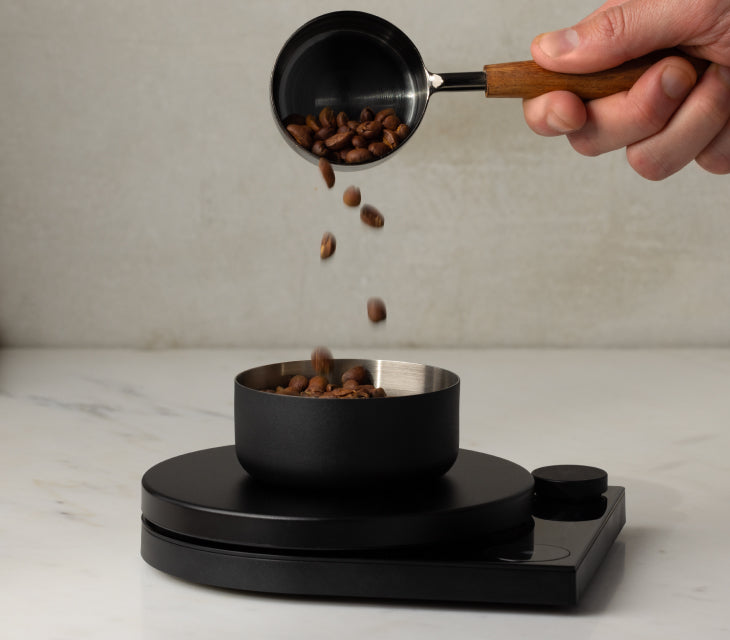
A scale
It should fit on your machine's drainage screen to weigh the overall yield out. As they say in the barista world, weigh your ins and outs!

An espresso towel
This is a towel or rag (preferably a microfiber towel) to clean and dry out your portafilter between shots.

Coffee
While medium-to-dark roasts are generally used for espresso, it's all down to your flavor preferences. Feel free to experiment!

1. Measure and grind your coffee
Measure out 18 g of coffee beans. You'll be pulling 36 g of liquid out. If you're using Espresso Series 1, you can use the preset espresso profiles and it will tell you how much coffee to use, typically 18 g.
Espresso grind settings can vary wildly grinder to grinder. Opus Conical Burr Grinder has a suggested range on the inside lid, and we recommend starting somewhere in the middle of that range. Always remember to grind finer to slow down your shot, and coarser to speed it up.

2. Distribute and tamp your grounds
Place your portafilter on your scale and tare it, then distribute the grounds evenly inside the portafilter. You can use two fingers or a distribution tool, just be sure not to use any downward pressure. Weigh your coffee in the portafilter again. If the weight has dropped you should adjust your espresso yield, maintaining a 1:2 coffee-to-water ratio.
Tamp using your tamping arm as a column without exerting too much pressure. We like to lean into it partially: if you're tamping with your right arm, raise your right foot. The force you use should remain consistent shot-to-shot.

3. Pull your shot at 9 bars
Make sure the water in your espresso machine is at 200°F and lock your portafilter to your espresso machine. Place a vessel below it, and pull your shot at around 9 bars. If you're using Espresso Series 1, the preset espresso profiles will give you the correct temperature and pressure for your shot, from pre-infusion to ramp down, and you can adjust these to taste.
Ideally you'll have your scale under your vessel, keeping it clear of the edges of the grill and the back of the espresso machine so as not to skew the weight results. The process should take 25-35 seconds average, but anywhere between 22-40 seconds.

4. Sip, savor, and experiment
We recommend using this recipe as a starting point, and experimenting to suit the coffee you're brewing with and find the flavors you enjoy. If you're tasting your espresso and it is overly sour, salty, or weak and pulling on the quicker side of the shot range, make the grind finer. If you're finding the shot is finishing chalky or overly bitter and it is pulling in the longer end of the shot time range, make the grind setting coarser.
Remember, with espresso, micro-adjustments go a long way! With Espresso Series 1, experimenting is easy: you can control pressure, temperature, and flow, and save your settings for future use.
FAQ
How do I pick the right coffee beans?
Coffee is very subjective. Everyone has their own preferences, and none are incorrect! However, we suggest starting with flavor notes that sound appealing to you. Experiment with flavor notes you're familiar with, and start to take note of the coffees you like: their origin and processing method (washed, honey, natural, maybe even anaerobic?).
Do my coffee beans have to have "espresso" in the name, or will any blend / single origin do?
Again, coffee is super subjective! Very often, roasters add "espresso" or "espresso blend" to the name of their coffee to denote a profile optimized for espresso– but that doesn't exclude it from being delicious as a pour-over! By that same token, coffees not labeled with "espresso" can be used to make delicious espresso. It all comes down to flavor notes and roast profile, and different flavor notes / roast profiles will lend themselves better to different types of espresso shots (higher or lower ratios, different temperatures, different pressure). Go with what you like and get to experimenting!
How do I know what setting to grind beans at?
If you're an Opus user, there should be a range offered for espresso on the underside of your hopper lid. We would recommend starting with a setting that's in the middle of your grinder's espresso range. Adjust your setting to be coarser if your final cup is too bold, chalky, or bitter. Adjust your setting to be finer if your coffee is too sour, watery, or lacking in body aka "weak". In the coffee world, this process is called "dialing in".
What is "channeling"? How can you tell a shot is "channeling"?
Channeling is generally considered a bad thing. This is the process in which water takes the path of least resistance through grounds, usually through an area where grounds aren't tightly packed in the portafilter because they weren't distributed evenly before tamping. You can see this with a bottomless portafilter by looking up at the shot as it pulls. You want to see "tiger striping" or relatively even stripes in color as the coffee comes out, and one steady stream of coffee instead of multiple. It's harder to see in a shot splitter, but you'll be able to tell by the thin, weak, and overly bitter taste.
What is "settling", and should I settle?
Settling refers to hitting the bottom of the portafilter (if it's bottomless) or just the top tip of the bottom of the portafilter (if it's spouted) against a countertop or hard surface you're using to tamp in order to bring down or "settle" the grounds into place. This typically closes some air pockets present in the grounds after grinding and before distribution. Whether you settle or not, just make sure to keep it a consistent part of your routine. That way, it is not a variable.
What do I do if my coffee tastes sour or bitter?
If your coffee tastes sour, try making your grind setting a bit finer. If your coffee tastes bitter, try making your grind setting a little coarser! Overly sour or watery flavor in coffee often denotes what we call "under extraction", or not pulling enough flavor from the coffee. Overly bitter, drying, or chalky flavor in coffee often denotes what we call "over extraction", or pulling too much flavor from the coffee.
What does "bar" or "bars" mean in reference to espresso machines and shots?
A bar is a unit of measurement for the amount of water pressure as it passes from an espresso machine through coffee grounds when pulling a shot. Each bar is 1 atmosphere, so 9 bars (standard pressure in an espresso machine) is 9 times the Earth's atmospheric pressure.
Perfect coffees for espresso
Ready to try your hand? Discover our curated collection of coffees, ideal for espresso.